





Home » Ayurvedic Classical Medicine » Ayurvedic Classical Syrup » Triphala Syrup

Triphala Syrup
Composition : Each 10ml Contains Trifla 1250 mg , (Terminalia Blerica ( F.r ), Emblica Officinalis (F.r) & Terminalia belerica (F.r) all in equal quantities) Preservative Sod: Benzoate 0.5% Citric Acid.
Triphala has been used in traditional Ayurvedic medicine since ancient times as a multi-purpose treatment for symptoms ranging from stomach ailments to dental cavities. It is also believed to promote longevity and overall health.
It’s considered a polyherbal medicine, meaning it consists of several different medicinal herbs.
Polyherbal formulations are popularly used in Ayurvedic medicine, a traditional system that emphasizes disease prevention and health promotion.
It’s believed that combining synergistic herbs results in extra therapeutic effectiveness and is a more powerful treatment than any one component taken alone (3Trusted Source).
Triphala is a mixture of the dried fruits of the following three plants native to India.
About Amla, It consists of pericarp of dried mature fruits of Emblica officinalis Gaertn. Syn. Phyllanthus emblica Linn. (Fam. Euphorbiaceae); mostly collected in winter season after ripening and in Kashmir in summer, a small or medium sized tree, found both in natural state in mixed deciduous forests of the country ascending to 1300 m on hills; cultivated in gardens, homeyards or grown as a road side tree.
SYNONYMS
Sanskrit : Amrtaphala, Amalaka, Dhatriphala
Assamese : Amlakhi, Amlakhu, Amlaku
Bengali : Amla, Dhatri
English : Emblic Myrobalan
Gujrati : Ambala, Amala
Hindi : Amla, Aonla
Kannada : Nellikayi, Bela nelli, pottadenollikayi
Kashmiri : Amli, Embali
Malayalam : Nellikka
Marathi : Anvala, Avalkathi
Oriya : Ainla, Anala
Punjabi : Aula, amla
Tamil : Nellikkai, nelli
Telugu : Usirika
Urdu : Amla, Amlaj
More commonly known as Indian gooseberry, amla plays an important role in Ayurvedic medicine. It is one of the oldest edible fruits known to India. Indian gooseberries are the edible fruit of a small to medium-sized tree that grows throughout India.The berries have a sour, sharp taste and a fibrous texture.For this reason, the berries are often pickled, soaked in sugar syrup or cooked into dishes to increase palatability.Indian gooseberry and its extract are used in Ayurvedic medicine to treat symptoms like constipation and also used in cancer prevention. Indian gooseberries are very nutritious and high in vitamin C, amino acids and minerals .They also contain powerful plant compounds like phenols, tannins, phyllembelic acid, rutin, curcuminoids and emblicol. Several test-tube studies suggest that Indian gooseberries have potent anti-cancer properties.For example, in test-tube studies, Indian gooseberry extract has been shown to inhibit the growth of cervical and ovarian cancer cells. However, there is no evidence that Indian gooseberries prevent cancer in humans.
About Bhibhitaki, It consists of pericarp of dried ripe fruits of Terntinalia belerica Roxb. (Fam. Combretaceae), a large deciduous tree, 10-12 m or more high, commonly found in plain and forests upto 900 m elevation, fruits ripen towards November.
SYNONYMS
Sanskrit : Vibhita,
Assamese : Bhomora, Bhomra, Bhaira
Bengali : Bayada, Baheda
English : Beleric Myrobalan
Gujrati : Bahedan
Hindi : Bahera
Kannada : Tare kai, Shanti Kayi
Kashmiri : Babelo, Balali
Malayalam : Tannikka
Marathi : Baheda
Oriya : Baheda
Punjabi : Bahera
Tamil : Thanrikkai
Telugu : Thanikkaya
Urdu : Bahera
Terminalia bellirica is a large tree that commonly grows in Southeast Asia. It’s known as “Bhibhitaki” in Ayurvedic medicine, where the fruit of the tree is used as a treatment for common ailments like bacterial and viral infections. Bhibhitaki contains tannins, ellagic acid, gallic acid, lignans and flavones, along with many other powerful plant compounds that are thought to be responsible for its medicinal qualities. This potent herbal remedy has a variety of uses and may help treat a wide array of medical issues. In particular, Bhibhitaki has been researched for its anti-inflammatory properties. In one study, 500 mg of Terminalia bellirica substantially reduced uric acid levels in patients with gout, an inflammatory condition characterized by the buildup of uric acid in the body.Bibhitaki is also commonly used in Ayurvedic medicine to treat diabetes and blood sugar dysregulation. This is because Bhibhitaki is high in gallic acid and ellagic acid, two phytochemicals that have beneficial effects on blood sugar levels, insulin sensitivity and body weight. These plant chemicals help promote insulin secretion from the pancreas and have been shown to reduce high blood sugar and improve insulin resistance in animal studies.
About Haritaki (Frt.), consists of the pericarp of mature fruits of Terminalia chebula Retz.
(Fam. Combretaceae), a moderate sized or large tree found throughout India, chiefly in
deciduous forests and areas of light rainfall, but occasionally also in slightly moist forests,
upto about 1500 m elevation, throughout India, flowers appear from April, August and
fruits ripen from October-January.
SYNONYMS
Sanskrit : Abhaya, Kayastha,
Assamese : Shilikha
Bengali : Haritaki
English : Myrobalan
Gujrati : Hirdo, Himaja, Pulo-harda
Hindi : Harre, Harad, Harar
Kannada : Alalekai
Kashmiri : Halela
Malayalam : Katukka
Marathi : Hirda, Haritaki, Harda, Hireda
Oriya : Harida
Punjabi : Halela, Harar
Tamil : Kadukkai
Telugu : Karaka, Karakkaya
Urdu : Halela
Terminalia chebula is a medicinal tree that grows throughout the Middle East, India, China and Thailand. This plant is known as “Haritaki” in Ayurveda, where the small, green fruit of the Terminalia chebula tree is used as medicine. It is one of the main components of Triphala. Haritaki is held in high esteem in Ayurveda and often referred to as the “king of medicines.” It has been used since ancient times as a remedy for a number of conditions, including heart disease, asthma, ulcers and stomach ailments. Haritaki contains phytochemicals such as terpenes, polyphenols, anthocyanins and flavonoids, all of which have powerful health benefits. Studies have shown that haritaki has powerful anti-inflammatory and antioxidant properties. Additionally, Haritaki is popularly used in Ayurvedic medicine to treat digestive issues like constipation. Animal studies have shown that treatment with Haritaki increases intestinal transit time, which can help relieve constipation.
It may help you lose weight loss
Triphala is a powerful detoxifier. It helps to flush out toxins from the stomach, small intestine and large intestine. The mixture also acts as a colon toner and helps in strengthening and toning the tissues of the colon, which keep your digestive system healthy. A healthy digestive system speeds up the digestion process helps fight constipation and help you manage weight.
It may fight against cancer
In a lab study, this Ayurvedic mixture has also proven to be effective in curbing the growth of cancerous cells. The compound present in it can inhibit the growth of lymphoma, as well as stomach and pancreatic cancers in a test carried out on mice. Triphala contains powerful antioxidants like gallic acid and polyphenols that are believed to help fight cancer.
It may reduce inflammation in the body
Triphala contains several antioxidants that perform protective functions in the body. It is loaded with compounds like flavonoids, polyphenols, tannins and saponins that can help to fight oxidative stress caused by free radicals and prevent you from chronic diseases. Regular consumption of Triphala has shown to cut down the risk of heart disease, certain cancers, diabetes, arthritis and premature ageing.
It may protect from dental problems
Triphala has antimicrobial and anti-inflammatory properties that can protect you from several dental problems. It can prevent plaque formation, cavities and gingivitis. As per clinical research, rinsing with Triphala mouthwash can prevent plaque and fungal infection. Its antioxidant properties can also heal mouth sores.
It may improve skin quality
Apart from ingesting it, some people also apply Triphala tropically on their skin. It is believed that its anti-inflammatory and antioxidant properties may help heal certain skin issues and protect skin cells. According to a study, applying Triphala paste on the skin can help to rebuild skin protein, retain moisture in the skin, increase collagen formation and help you recover from wounds speedily.
It may reduce stress and anxiety
Taking the mixture of the three herbal fruits could also be effective for your mental health. Several studies prove that taking Triphala can protect against stress and help your body to cope up with it. Another study revealed that the mixture can help reverse some behavioural issues caused by stress.
It may be used as a natural laxative
Triphala has been used since ancient times for treating stomach related issues. It acts as a natural laxative and can improve the symptoms of constipation, abdominal pain, flatulence and improve the frequency and consistency of bowel movements.
Dose :5 to 10 ml. 2-3 times a day or as directed by the physician.
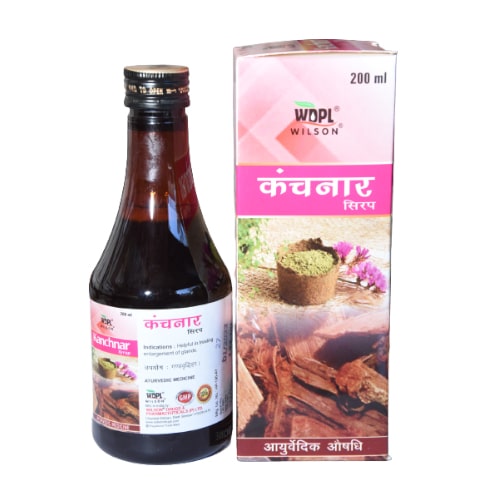
Packaging Details: 200ml & 450 ml
© 2026 Wilson Drugs.All Rights Reserved. || Web Development and Designing By WebHopers